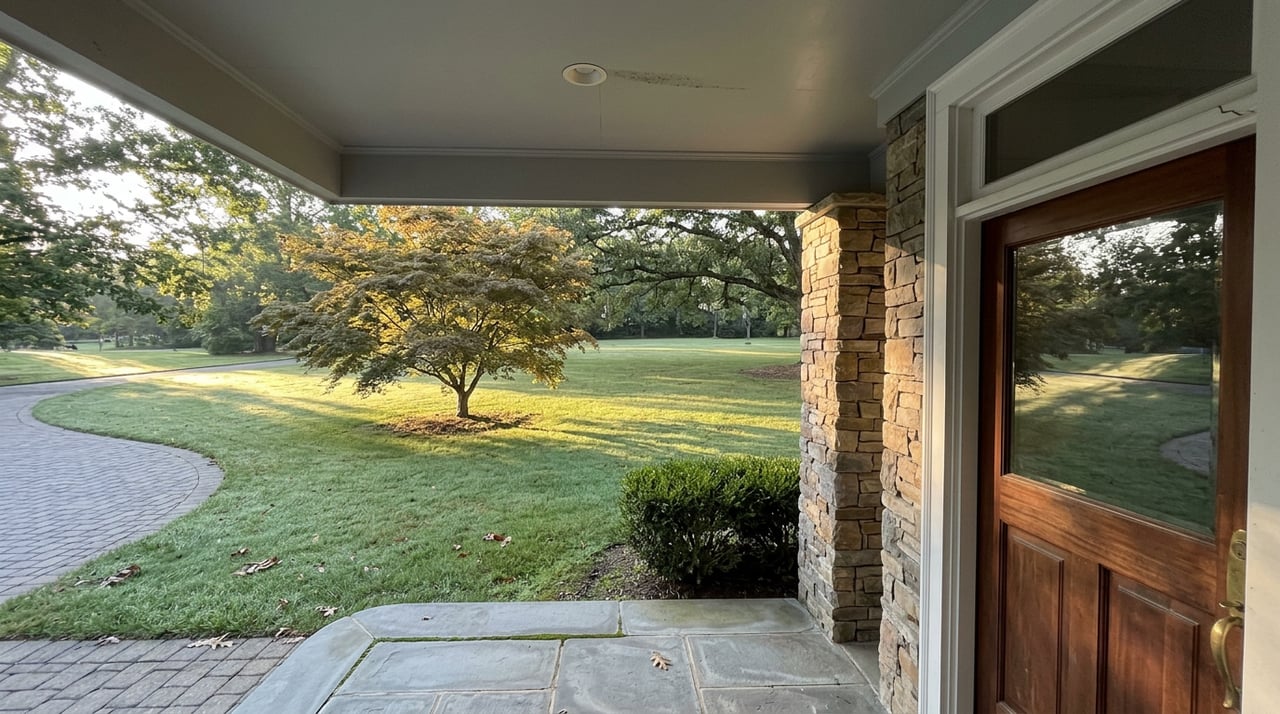
On September 12, the Brook Run Park Amphitheater hosted the last Groovin' on the Green show of the year. The venue seats 500 on terraced steps and holds up to 2,000 people once you count the Great Lawn spilling out around the pavilion. That capacity existed because the concert series has been building an audience since the amphitheater opened in 2020, and this year's run started June 13 with Band X and Nero Simon, added M-80s and Herd Behavior on August 8, and closed out with the September 12 show. Then the lawn went quiet.
One week later, on the morning of September 19, the same 110 acres were full again. Not for a concert. For the DHA Farmers Market, which set up at the front entrance across from the playground the way it has every Saturday since 2018, and will keep doing so every Saturday through December 19.
If you only follow one calendar for this park, that contrast looks like a contradiction. The season "ended," and then it obviously didn't. The truth is that Brook Run doesn't run on one calendar. It runs on at least three, stacked on top of each other, controlled by three different organizations that have nothing to do with each other's scheduling decisions. Understanding that layering is the difference between feeling like you missed something and knowing exactly which corner of the fall calendar to watch next.
The Market Doesn't Answer to the Concert Series
The Dunwoody Homeowners Association runs the farmers market. The City of Dunwoody Parks and Recreation Department runs Groovin' on the Green. They share a park, not a schedule.
The market's 2026 season runs from January 17 through December 19, with the only two closures falling on April 25 for Lemonade Days and on July 4. That is a ten-and-a-half month run for an event that pulls 30 to 35 rotating vendors selling produce, pasture-raised meat, seafood, baked goods, and coffee, every single Saturday, rain or shine, with free parking and leashed dogs welcome. The concert series, by contrast, is a June-through-September program built around six or seven Saturday nights a summer.
So when the amphitheater emptied out after September 12, nothing about the market changed. It is not winding down for fall. It still has exactly three more months to run before its final Saturday on December 19, including a stretch of Holiday Markets on December 5, 12, and 19. If you assumed the whole park quiets down once the concerts stop, you would miss roughly thirteen more Saturdays of exactly the same market that's been running since 2018.
Across Town, a Different Nonprofit Is Just Getting Started
While Brook Run's concert calendar wound down, a different organization was gearing up a few miles away. Create Dunwoody is holding its first-ever Explorefest on Saturday, October 3, from 10 a.m. to 2 p.m., not at Brook Run but at the Williamsburg Shopping Center at Mount Vernon and Jett Ferry Roads. The free, family-friendly event is built specifically to activate that commercial stretch of Dunwoody, drawing people toward the local businesses clustered around Williamsburg the same way Brook Run's programming has trained people to gather there.
That distinction matters if you live here. Brook Run's calendar and the Williamsburg corridor's calendar are run by different groups with different goals. One is trying to keep a 110-acre park full every Saturday of the year. The other is trying to put a commercial strip on the map for the first time. Watching only the park page means missing an entirely new event happening a short drive away, in a part of town that doesn't usually make anyone's weekend list.
The Art Scene Runs on Its Own Clock, Too
Then there's the third layer, and it moved this month. The Spruill Gallery's final exhibition of 2026, called Material Poesy, opens September 24 and features work from Atlanta-based artists Johanna Flores, Ato Ribeiro, and Ivy Wu. The opening reception runs September 25 from 6 to 9 p.m., and there's an artists' talk scheduled for October 11 at 2 p.m. None of that overlaps with Brook Run's calendar or the Williamsburg activation. It's a separate gallery with a separate season, closing out its own year on its own timeline, unconnected to when the Great Lawn goes quiet or when Explorefest kicks off.
The art world had another reason to notice Dunwoody this month. Sunshine Artist Magazine named the Dunwoody Art Festival to its 2026 "200 Best" list of classic and contemporary craft events nationwide, ranking it 78th in the country based on artists' reported sales from the previous year. That's a national ranking landing on a local festival most residents already knew about, which is its own kind of confirmation that the layers of programming running through this city aren't just busy. They're drawing attention from outside it, too.
Why the Layering Is the Actual Story
None of this is disorganized. It's the predictable result of a park system that Dunwoody had to build from almost nothing. The city didn't exist until it incorporated on December 1, 2008, and before that, DeKalb County ran what parks there were. Brook Run existed back then too, but without the trail system, the splash pad, or the amphitheater that came later. Once Dunwoody took over its own parks department, three separate ecosystems grew up around the same public land: a homeowners association running a market, a city department running concerts and maintaining the Brook Run Park facilities, and a cluster of arts nonprofits running galleries and festivals on their own separate calendars.
What ties the physical geography together is the Dunwoody Trailway, a wide multi-use path that loops 1.8 miles around Brook Run itself, connects onward to Pernoshal Park (the two together add up to roughly a 5K), and continues from there to Georgetown Park. That trail is the one piece of infrastructure that lets a resident actually string these separate calendars into a single Saturday. Walk the market at 9, keep going on the Trailway toward Pernoshal, loop back by noon. The three organizations running the programming never had to coordinate with each other because the trail already does the work of connecting their footprints.
What This Means for the Rest of Your Fall
If you want to catch everything, you need more than one source. The City of Dunwoody's parks calendar covers concerts, movie nights, and anything happening on city-owned land. The DHA's Facebook page covers the weekly vendor lineup at the market, which changes from Saturday to Saturday. Discover Dunwoody and Create Dunwoody cover the arts side and cross-town activations like Explorefest, which won't show up on the city's own event page because it isn't a city event.
None of these calendars talk to each other, and that's fine. It means the amphitheater going quiet on September 12 wasn't the neighborhood slowing down. It was one layer handing off to the next. The market keeps running into December. The gallery opens a new show this week. A shopping center that's never had its own festival gets one on October 3. Dunwoody's fall calendar isn't thinner than its summer one. It's just distributed across more organizations than most people are tracking at once.
That kind of layered, overlapping civic life is part of what makes a place feel lived-in rather than just decorated for visitors. It's also the kind of detail that only shows up if you're paying attention to a neighborhood over years, not just checking a single events page before a Saturday.
If you're the kind of person who tracks a neighborhood this closely because you're thinking about your next move here, or because you're simply curious what your home might be worth in a market this active, the Teri Frye team has spent years watching how North Atlanta neighborhoods like Dunwoody actually run, layer by layer. Get an Instant Home Valuation and see where your Dunwoody home stands today.